AnxietyAidTools

Evidence-based mental health tools
10–15 min

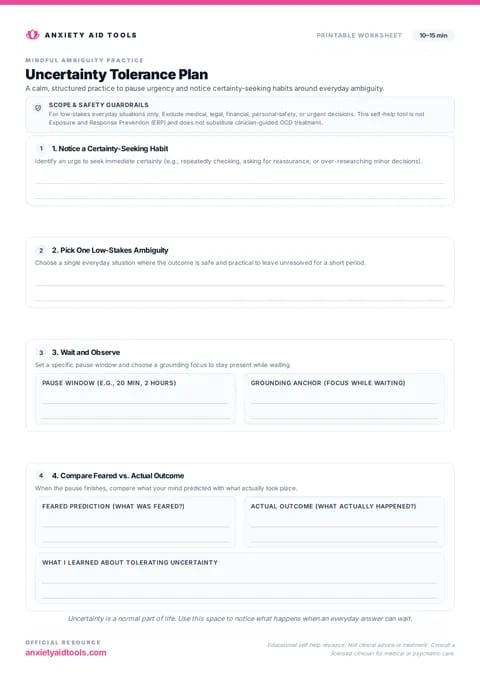
Uncertainty Tolerance Plan

A structured reflection for noticing everyday certainty-seeking, trying one low-stakes ambiguity, and comparing a feared outcome with what actually happened.

Anxiety & Worry
Beginner
10–15 min
Uncertainty Tolerance Plan
Pro download PDF & PNG

Overview

Print for offline use during therapy or self-practice

Printable PDF and PNG formats available in your Pro dashboard

When to Use

  • When you notice an everyday urge to check, ask for reassurance, research, or decide immediately
  • For one low-stakes situation where waiting is safe and practical
  • When you want to observe what happens without resolving every uncertainty
  • After the situation, when you can compare the feared and actual outcomes

How to Use

  1. 1
    Notice and describe the certainty-seeking habit you want to observe.
  2. 2
    Choose one ambiguity that is low-stakes and does not involve medical, legal, financial, personal-safety, or urgent decisions.
  3. 3
    Write what you fear might happen and decide how you will wait and observe.
  4. 4
    Leave the uncertainty unresolved for the chosen period while continuing with your ordinary activities.
  5. 5
    Record what actually happened, including what remained unknown.
  6. 6
    Compare the feared and actual outcomes without treating either one as a guarantee about future situations.

The Uncertainty Tolerance Plan helps you notice an everyday habit of seeking certainty, such as checking, asking for reassurance, researching, or deciding immediately. It is a reflection tool, not a diagnostic measure and not a promise of a particular outcome.

Choose one low-stakes ambiguity that is safe to leave unresolved for a while. Do not use this worksheet for medical, legal, financial, personal-safety, or urgent decisions; make those decisions or seek appropriate support instead.

Wait and observe without trying to settle the uncertainty, then compare the feared outcome with the actual outcome. This worksheet is not ERP and is not a substitute for clinician-guided OCD treatment.
Research & References

  • Dugas, M. J., Gagnon, F., Ladouceur, R., & Freeston, M. H. (1998). Generalized anxiety disorder: A preliminary test of a conceptual model. Behaviour Research and Therapy, 36(2), 215-226.
  • Centre for Clinical Interventions (2022). What? Me Worry!? Managing Worries. CCI Self-Help Resources.