AnxietyAidTools

Evidence-based mental health tools
5 min

Personal Grounding Menu

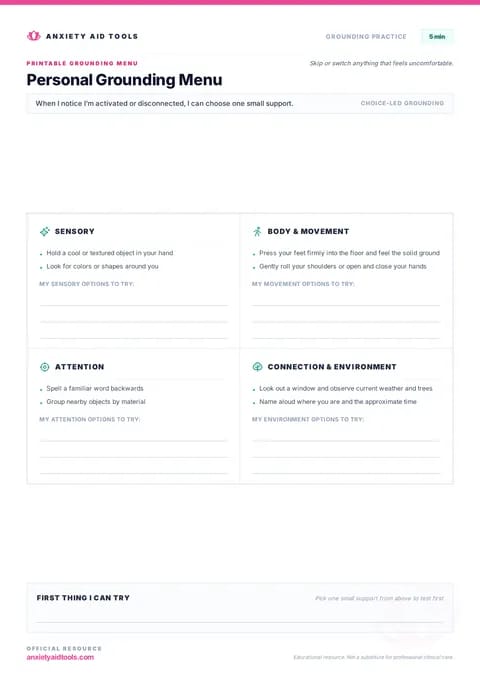
A short, advance-planning menu for choosing a few grounding options to keep available during stress or disconnection.

Grounding
Beginner
5 min
Personal Grounding Menu
Pro download PDF & PNG

Overview

Print for offline use during therapy or self-practice

Printable PDF and PNG formats available in your Pro dashboard

When to Use

  • During a calm moment, before a stressful or triggering situation
  • When you want a short list rather than a fixed sensory exercise
  • When you notice early signs of feeling activated, numb, or disconnected
  • When preparing a low-pressure grounding reference to keep nearby

How to Use

  1. 1
    Read the menu ahead of time, when you have enough space to consider your preferences.
  2. 2
    Choose a few options you would be willing to try; leave out anything you do not want to use.
  3. 3
    Consider privacy, physical comfort, accessibility, and what fits the situation you may be in.
  4. 4
    Keep the reference easy to find and review it when your needs or circumstances change.
  5. 5
    When a difficult moment arrives, try one option only if it feels appropriate; skip, stop, or switch if it does not.
  6. 6
    If you feel unsafe or need urgent help, use a crisis or safety plan and contact local emergency or crisis support.

The Personal Grounding Menu is a brief reference for considering grounding options before a stressful moment arrives. It keeps the focus on a small set of concrete ways to orient to the present, notice your surroundings, or reconnect with a sense of steadiness.

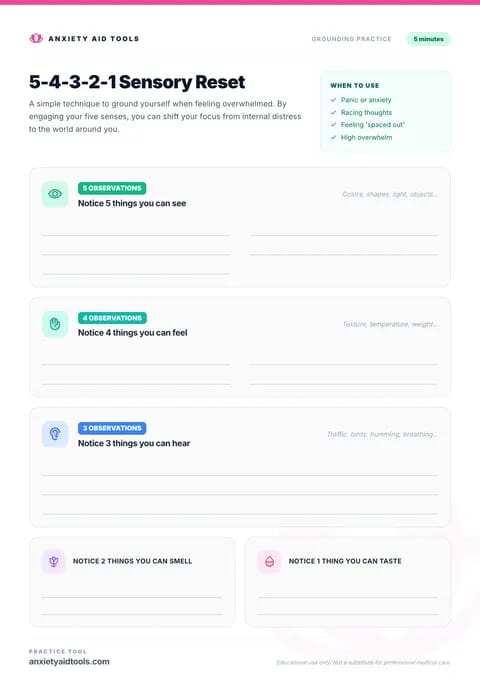
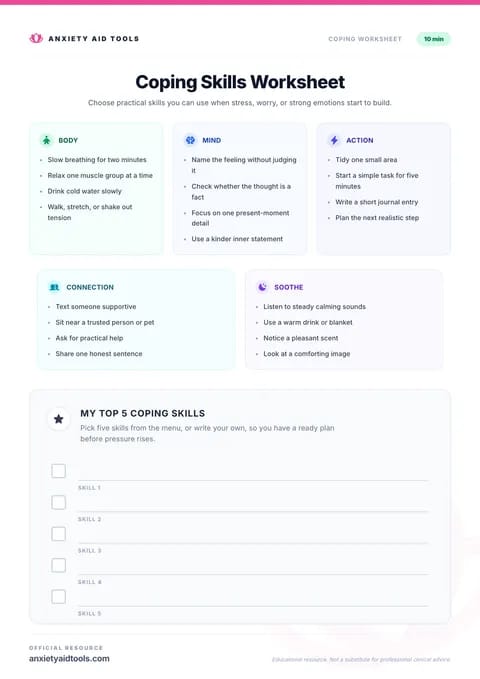
This is intentionally different from the 5-4-3-2-1 Sensory Reset: it is not a fixed sequence or a count-through-the-senses exercise. It is also narrower than the Coping Skills Worksheet, which organizes a broader range of body, mind, action, connection, and soothing strategies. Use this menu to choose only the options that feel acceptable and practical for you.

Review the menu during a relatively calm moment and revisit it when your circumstances change. A plan is an invitation, not a requirement: you can skip an option, stop, choose nothing, or seek support. This reference is not a crisis or safety plan.
Research & References

  • Najavits, L. M. (2002). Seeking Safety: A Treatment Manual for PTSD and Substance Abuse. Guilford Press.
  • Substance Abuse and Mental Health Services Administration (2014). Trauma-Informed Care in Behavioral Health Services. Treatment Improvement Protocol (TIP) Series, No. 57.