AnxietyAidTools

Evidence-based mental health tools
3–5 min

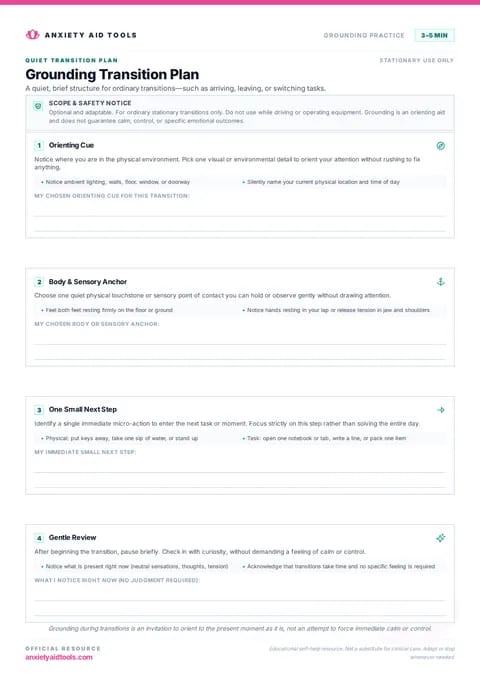
Grounding Transition Plan

A quiet, brief plan for ordinary transitions—such as arriving, leaving, or switching tasks—to orient attention, choose a body anchor, and take one small step.

Grounding
Beginner
3–5 min
Grounding Transition Plan
Pro download PDF & PNG

Overview

Print for offline use during therapy or self-practice

Printable PDF and PNG formats available in your Pro dashboard

When to Use

  • When arriving at or leaving home, work, school, or a social setting
  • During task switching, such as moving between demanding projects or wrapping up a meeting
  • When you notice feelings of rushing, mental drift, or disorientation between activities
  • As a quiet stationary pause before beginning the next part of your day

How to Use

  1. 1
    Choose an orienting cue in your immediate physical environment (e.g., notice the lighting, a doorway, or name your location).
  2. 2
    Select one quiet body or sensory anchor (e.g., feel your feet on the ground or hands in your lap).
  3. 3
    Identify one small next step to begin the next task or moment without trying to solve the rest of the day.
  4. 4
    Take that single step, then pause for a gentle review to notice how things feel without expecting or forcing calm.
  5. 5
    Remember this exercise is optional and adaptable; skip or modify any part as needed.

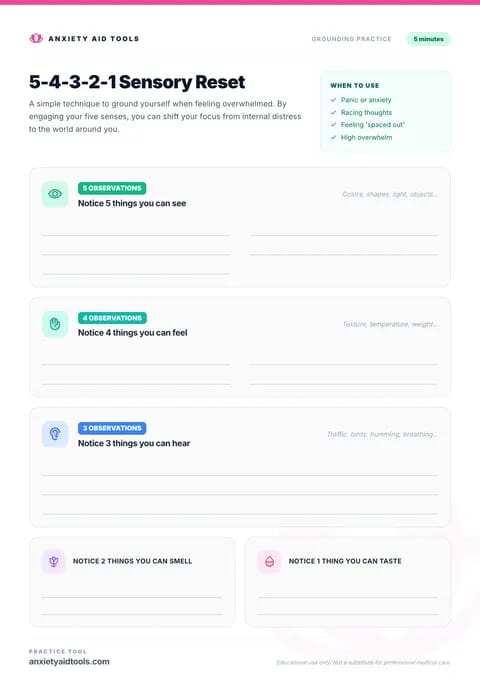
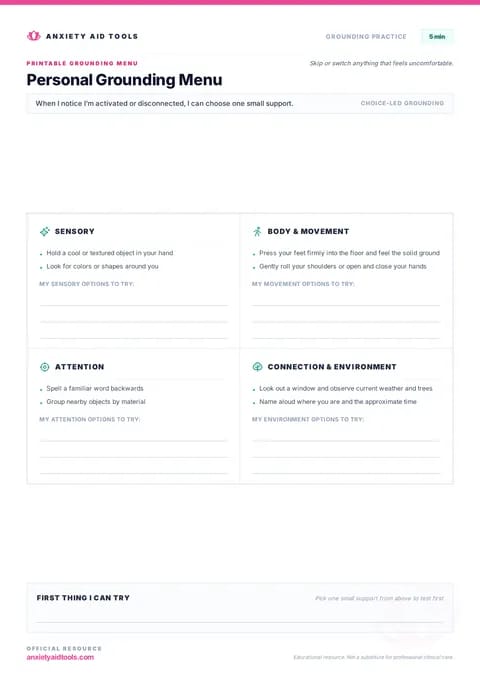
The Grounding Transition Plan provides a quiet, brief structure for ordinary daily transitions, such as arriving at a location, leaving a space, or switching between tasks. It complements broader grounding tools, like the 5-4-3-2-1 Sensory Reset and Personal Grounding Menu, by focusing on one immediate moment of shifting focus.

Through four simple steps—one orienting cue, one body or sensory anchor, one small next step, and a gentle review—it helps you acknowledge where you are and proceed at your own pace without demanding sudden calm or emotional control.

This practice is optional, adaptable, and clinically cautious. It is intended strictly for ordinary stationary transitions and must never be used while driving, cycling, or operating machinery or equipment. It is an orienting aid rather than a promise of calm or guaranteed outcomes.
Research & References

  • Najavits, L. M. (2002). Seeking Safety: A Treatment Manual for PTSD and Substance Abuse. Guilford Press.
  • Substance Abuse and Mental Health Services Administration (2014). Trauma-Informed Care in Behavioral Health Services. Treatment Improvement Protocol (TIP) Series, No. 57.