AnxietyAidTools

Evidence-based mental health tools
10 min

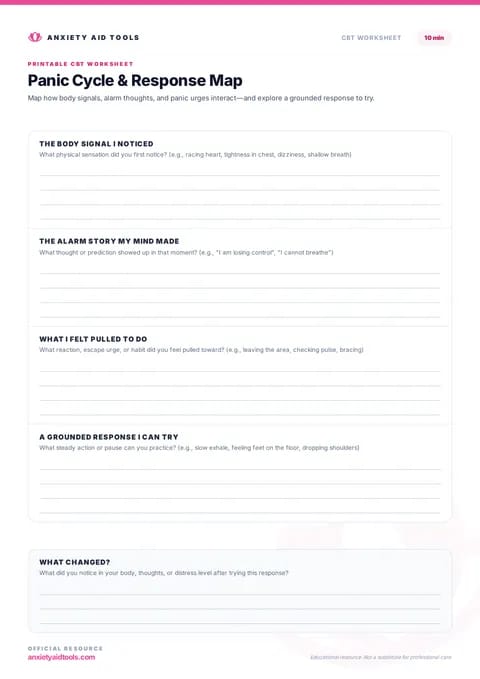
Panic Cycle & Response Map

Map how body signals, alarm thoughts, and panic urges interact—and explore a grounded response to try.

Anxiety & Worry
Beginner
10 min
Panic Cycle & Response Map
Pro download PDF & PNG

Overview

Print for offline use during therapy or self-practice

Printable PDF and PNG formats available in your Pro dashboard

When to Use

  • After experiencing a panic surge or spiral to map what occurred
  • When preparing for a stressful situation to identify helpful grounding steps
  • When physical sensations and alarm thoughts feel intertwined
  • During CBT practice to observe personal panic patterns

How to Use

  1. 1
    Work through the four prompts in sequence after or between stressful episodes.
  2. 2
    In Step 1, note the body sensation you observed without judgment.
  3. 3
    In Step 2, write down the alarm thought or prediction that appeared.
  4. 4
    In Step 3, identify the reaction, urge, or habit you felt pulled toward.
  5. 5
    In Step 4, choose one grounded response or anchor to test.
  6. 6
    Use the reflection section below to observe what you noticed after trying that response.

The Panic Cycle & Response Map is a gentle, practical CBT worksheet designed to help deconstruct a recent or anticipated panic spiral. Panic often feels overwhelming, but it commonly involves a recognizable sequence: a noticeable body sensation is followed by an alarm thought, which can prompt an urge to fight, freeze, or flee.

By mapping each part of the pattern—Body Signal, Alarm Story, and Panic Urge—you can clarify how thoughts and physical sensations interact. The map offers a structured space to identify a Grounded Response you can test during or after high distress.

This psychoeducational worksheet offers a structured way to observe your patterns and practice supportive responses rather than diagnosing or offering clinical treatment.
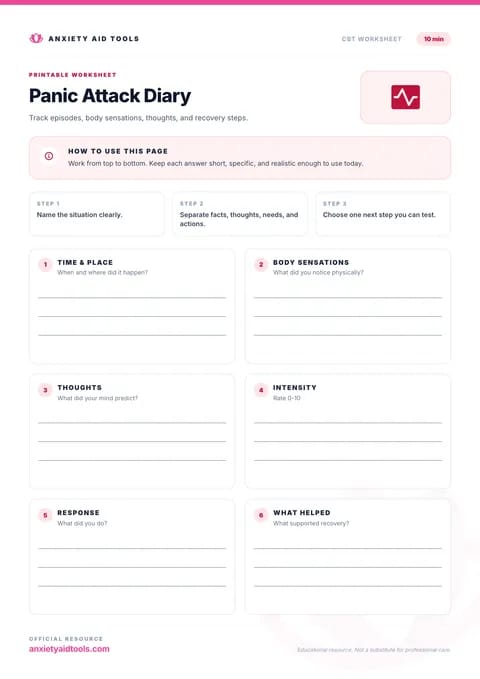
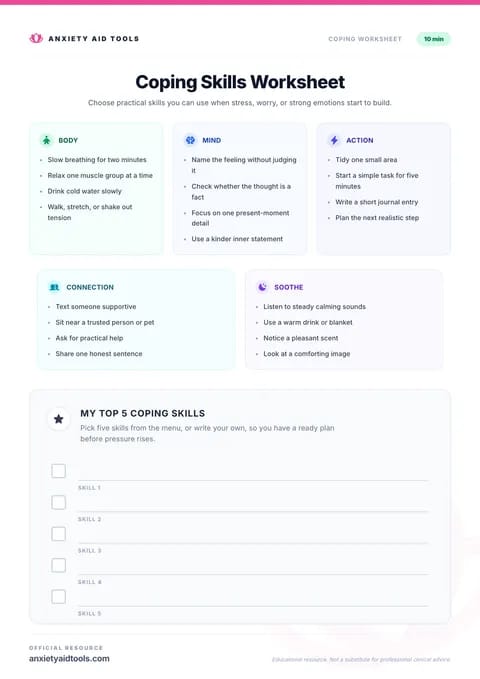
Research & References

  • Clark, D. M. (1986). A cognitive approach to panic. Behaviour Research and Therapy, 24(4), 461-470.
  • Barlow, D. H., & Craske, M. G. (2007). Mastery of Your Anxiety and Panic: Client Workbook (4th ed.). Oxford University Press.