AnxietyAidTools

Evidence-based mental health tools
15 min

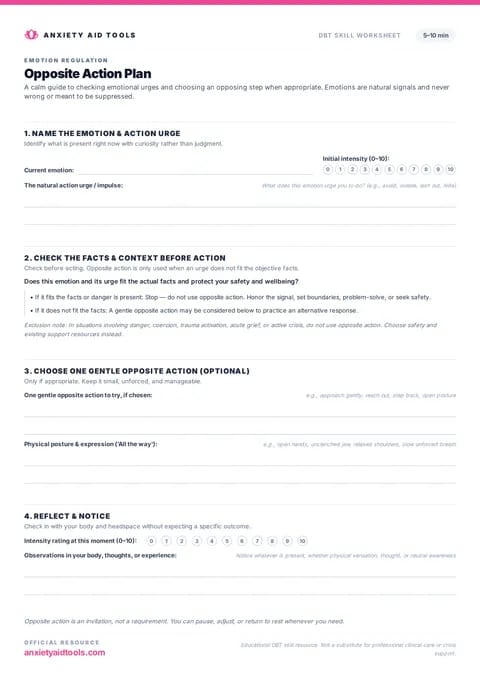
Opposite Action Plan

A DBT-informed worksheet for naming an emotion and its urge, checking the facts and context, and considering an optional gentle opposite action when it fits.

Mood & Depression
Intermediate
15 min
Opposite Action Plan
Pro download PDF & PNG

Overview

Print for offline use during therapy or self-practice

Printable PDF and PNG formats available in your Pro dashboard

When to Use

  • When an emotion brings a strong action urge
  • When you want to name your emotion and urge without judging them
  • When you need to check the facts and context before acting
  • When a safe, values-consistent response may gently move opposite to an unhelpful urge

How to Use

  1. 1
    Name the emotion and describe its intensity without trying to make it disappear.
  2. 2
    Write the action urge: what do you feel pulled to do, avoid, say, or stop doing?
  3. 3
    Record the observable facts and relevant context, including safety, power, relationship, and practical factors.
  4. 4
    Check whether the emotion and urge fit the facts, and note what the emotion may be communicating.
  5. 5
    Only if it is safe and appropriate, consider one small, gentle opposite action that serves your values; choosing no action or seeking support is also valid.
  6. 6
    Notice what happened without demanding a different feeling. If there is danger, coercion, trauma activation, acute grief, or an active crisis, prioritize safety and support instead of using this plan.

The Opposite Action Plan is a Dialectical Behavior Therapy (DBT) practice for naming an emotion and the action urge that comes with it. It starts with noticing what you feel and what you feel pulled to do, without judging or trying to change either one.

Next, the worksheet helps you check the facts and context: what happened, what the emotion may be signaling, whether the urge fits the situation, and what safety or relationship factors matter. This step comes before considering any action.

If the urge does not fit the facts and a different response would be safe and useful, you may consider one small, gentle opposite action that fits your values. The choice is optional, and you can pause, choose no action, or seek support. The emotion may remain; opposite action is not emotion suppression, forced positivity, or a demand to change your feelings.

Do not use this worksheet to override an urge related to danger or coercion; prioritize safety and support and use the Safety Plan. It is not for trauma activation or acute grief; consider the Trauma Reminder Response Plan, Personal Grounding Menu, or compassionate support instead. During an active crisis, stop and contact local emergency services or a crisis line, using your Safety Plan if you have one.
Research & References

  • Linehan, M. M. (2014). DBT Skills Training Manual. Guilford Press.
  • Neacsiu, A. D., Rizvi, S. L., & Linehan, M. M. (2010). Dialectical behavior therapy skills use as a mediator and outcome of treatment for borderline personality disorder. Behaviour Research and Therapy, 48(9), 832-839.