
Penn State Worry Questionnaire (PSWQ)
A 16-question self-reflection measure for understanding how persistent, excessive, or hard-to-control worry tends to show up in your daily life.
Who Is This Test For?
The PSWQ is for adults who want to understand how often worry feels persistent, overwhelming, or difficult to stop.
- People who feel caught in repeated what-if thinking
- Anyone who worries across many situations or responsibilities
- People tracking whether worry is becoming more manageable over time
- Anyone preparing to discuss persistent worry with a qualified professional
Read each statement and rate how typical it is of you.
If I don’t have enough time to do everything I do not worry about it
My worries overwhelm me
I do not tend to worry about things
Many situations make me worry
I know I should not worry about things, but I just can’t help it
When I am under pressure I worry a lot
I am always worrying about something
I find it easy to dismiss worrisome thoughts
As soon as I finish one task, I start to worry about everything else I have to do
I never worry about anything
When there is nothing more I can do about a concern, I don’t worry about it any more
I have been a worrier all my life
I notice that I have been worrying about things
Once I start worrying, I can’t stop
I worry all the time
I worry about projects until they are done
Turn self-test results into a clearer next step.
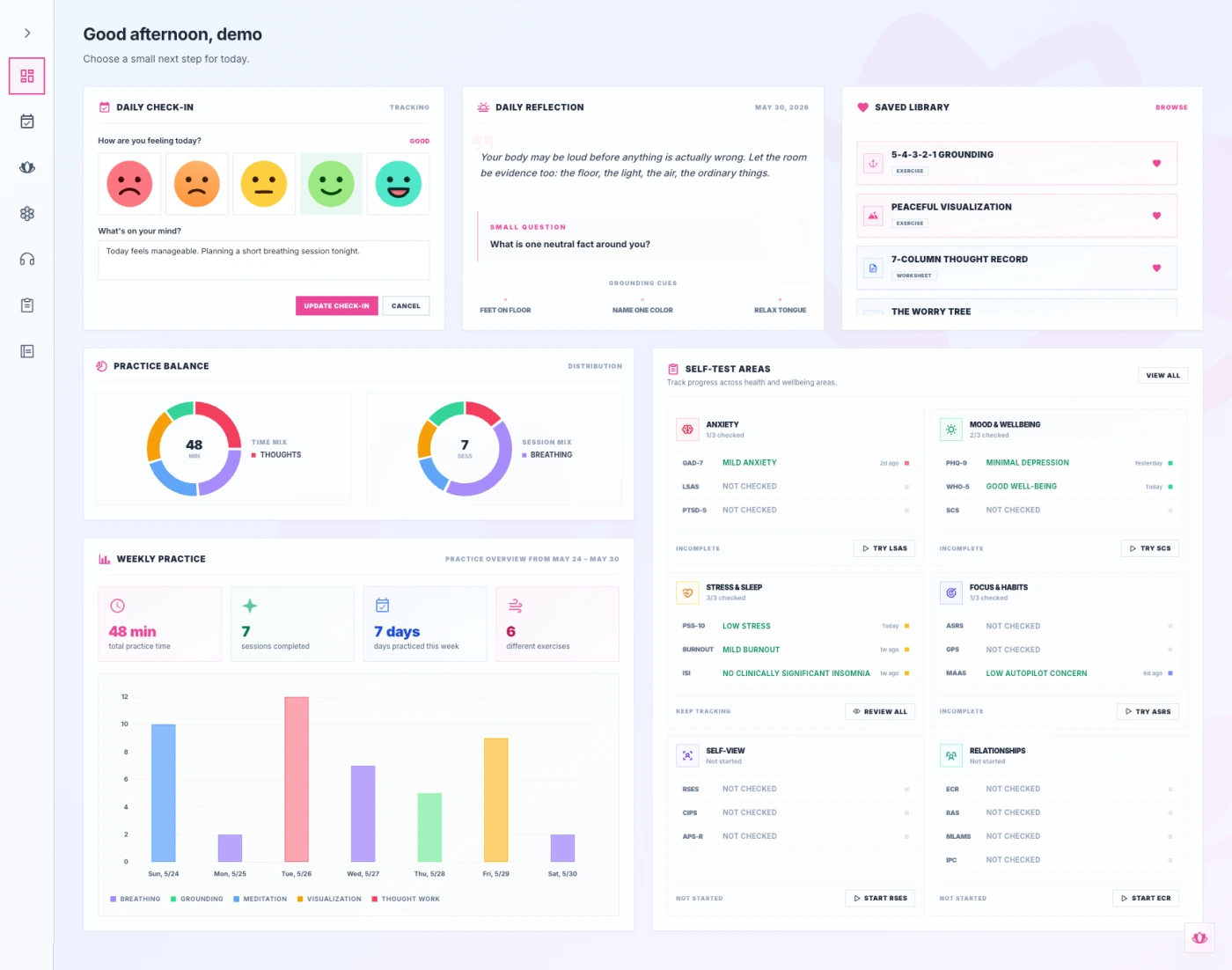
Save your results, watch changes over time, and find relevant tools when you need a next step.
- Save your history
- Track changes over time
- Find relevant tools
Retake tests over time to see what changes.
Good To Know

Separate Worry From Problem-Solving
Ask whether the concern has a concrete next action. If yes, write one step. If not, practice returning attention to the present instead of replaying scenarios.

Schedule a Worry Window
Postpone repeated worries to a short planned time. This helps your brain learn that every worry does not need immediate attention.

Practice Letting a Thought Pass
When a worry appears, label it as a worry thought and let it be present without arguing, checking, or solving it right away.
Understanding the PSWQ
T he Penn State Worry Questionnaire is a 16-item measure developed to assess the tendency toward persistent, excessive, and difficult-to-control worry. It is commonly used in research and clinical monitoring contexts.
Each item is rated from 1 to 5. Items 1, 3, 8, 10, and 11 are reverse scored, so the total score ranges from 16 to 80. Higher scores indicate a stronger persistent or pathological worry tendency.
The bands shown here are concern-based, non-diagnostic ranges. There is no universal clinical cutoff, and this self-test does not diagnose generalized anxiety disorder or any other condition.
As practical anchors, scores around 40 or higher may suggest more elevated worry in research or monitoring contexts, while scores around 55 or higher are treated as high worry in this app's non-diagnostic bands. Interpretation should consider distress, impairment, context, and professional judgment.
Frequently Asked Questions
What does the PSWQ measure?
The PSWQ measures a person's tendency toward persistent and hard-to-control worry. It focuses on the style and frequency of worry rather than one specific topic.
What does a high score mean?
A high score means your responses suggest more persistent worry. It can be useful for self-reflection or monitoring, but it is not a diagnosis and does not prove you have a specific disorder.
Can this test diagnose GAD?
No. The PSWQ is related to worry, which can be relevant to generalized anxiety disorder, but it does not diagnose GAD or any other condition. A qualified professional can provide a full assessment.
Why are some items reverse scored?
Some statements describe lower worry, such as being able to dismiss worries. These items are reverse scored so the total score consistently reflects higher worry when the total is higher.
What should I do if worry is disrupting my life?
If worry is causing significant distress, avoidance, sleep problems, relationship strain, or difficulty functioning, consider speaking with a qualified mental health professional. If you are in immediate danger or crisis, contact emergency services or a crisis hotline now.
More Tests



Sources & References
- CamCOPS Penn State Worry Questionnaire task documentation.
- CamCOPS Penn State Worry Questionnaire server implementation.
- Meyer TJ, Miller ML, Metzger RL, Borkovec TD. Development and validation of the Penn State Worry Questionnaire. Behaviour Research and Therapy. 1990;28(6):487-495.
- Penn State Pure record for the original PSWQ publication.
- NITRC Penn State Worry Questionnaire assessment page.
This self-test is for education and self-reflection only. It is not diagnostic and cannot replace an evaluation by a qualified mental health professional. Higher scores suggest a stronger persistent worry tendency, not a diagnosis or universal clinical cutoff. Seek qualified professional support if worry causes significant distress or impairment. If you are in immediate danger or crisis, contact emergency services or a crisis hotline now.