AnxietyAidTools

Evidence-based mental health tools
15 min

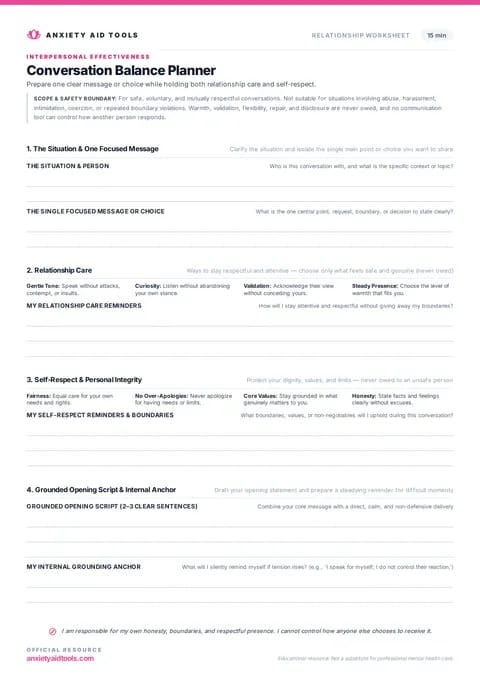
Conversation Balance Planner

Prepare one focused, respectful message or choice while balancing relationship care with self-respect.

Relationships
Intermediate
15 min
Conversation Balance Planner
Pro download PDF & PNG

Overview

Print for offline use during therapy or self-practice

Printable PDF and PNG formats available in your Pro dashboard

When to Use

  • Before a safe, mutually respectful conversation
  • When you want to balance relationship care with self-respect
  • When one message or choice needs a clear focus
  • When deciding whether to speak, write, pause, or step back

How to Use

  1. 1
    Check the scope: continue only if contact is safe, voluntary, and mutually respectful; do not use this planner for abuse, harassment, intimidation, coercion, or repeated boundary violations.
  2. 2
    Name the relationship care and self-respect you want to bring, without treating either as something another person owes you.
  3. 3
    Choose one focused message or choice, then write it in clear, honest language.
  4. 4
    Choose only the communication options that fit: fairness, clear boundaries, curiosity, or recognition without agreement.
  5. 5
    Choose whether to send, say, pause, or step back, without promising a particular response or trying to control the other person's response.

The Conversation Balance Planner is an everyday conversation preparation tool for a safe, mutually respectful relationship. It helps you balance care for the relationship with self-respect while keeping the conversation focused on one message or choice.

It draws lightly on FAST and GIVE skills: be fair, avoid unnecessary apologies, stay interested, choose a gentler manner, and recognize what you understand. These are optional ways to communicate, not duties, concessions, or guarantees.

Use it only for safe, voluntary, mutually respectful conversations. It is not for abuse, harassment, intimidation, coercion, or repeated boundary violations; if those are present, prioritize safety and support instead of preparing a more effective message.
Research & References

  • Linehan, M. M. (2014). DBT Skills Training Manual. Guilford Press.