
Satisfaction With Life Scale (SWLS)
A 5-question self-report measure of global life satisfaction, focused on how you evaluate your life as a whole.
Who Is This Test For?
The SWLS is for adults who want a brief reflection on how satisfied they feel with life overall.
- Adults who want to check in on overall life satisfaction
- People reflecting on wellbeing, values, goals, or life direction
- Anyone noticing a gap between current life and the life they want
- Those tracking how changes in life circumstances affect their overall satisfaction
Please read each statement carefully and indicate how much you agree or disagree with it.
In most ways my life is close to my ideal.
The conditions of my life are excellent.
I am satisfied with my life.
So far I have gotten the important things I want in life.
If I could live my life over, I would change almost nothing.
Turn self-test results into a clearer next step.
Save your results, watch changes over time, and find relevant tools when you need a next step.
- Save your history
- Track changes over time
- Find relevant tools
Retake tests over time to see what changes.
Good To Know

Map What Matters
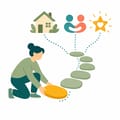
Write down the life areas that most shape your satisfaction: relationships, health, purpose, work, home, freedom, growth, or rest. Pick one area where a small, realistic improvement would matter this week.

Separate Conditions from Direction
Some life conditions may be hard to change quickly. Name one condition you need support with and one direction you can still move toward, even in a small way.
Notice Existing Fit
Each day for a week, note one moment that felt aligned with the life you want. This is not forced positivity; it helps you identify what to protect, repeat, or build from.
Understanding the Satisfaction With Life Scale
T he Satisfaction With Life Scale (SWLS) was developed by Diener and colleagues to measure global cognitive judgments of life satisfaction. It asks you to evaluate your life as a whole rather than focusing on momentary mood.
The scale has 5 items rated from Strongly disagree to Strongly agree. Each item is scored from 1 to 7, giving a total score from 5 to 35.
Higher scores indicate greater reported satisfaction with life. Score ranges are commonly described from extremely dissatisfied through very satisfied, but they should be understood as reflective categories rather than diagnoses.
The SWLS is a self-report wellbeing measure, not a clinical diagnostic tool. Scores can be influenced by current stress, culture, health, relationships, finances, expectations, and recent events. Exact item text is reproduced here for educational self-assessment based on the cited scale; copyright and licensing rights may remain with the original authors or publishers.
Frequently Asked Questions
What does the SWLS measure?
It measures your overall judgment of satisfaction with life. It is about how you evaluate your life as a whole, not a diagnosis, a personality label, or a direct measure of happiness in the moment.
How is the score calculated?
Each of the 5 items is scored from 1 to 7. The items are added for a total from 5 to 35, with higher scores indicating greater reported life satisfaction.
Does a low score mean something is wrong with me?
No. A lower score may reflect difficult circumstances, unmet needs, stress, loss, or a gap between your current life and what matters to you. It can be useful information, not a verdict on you.
Can life satisfaction change over time?
Yes. Life satisfaction can shift with relationships, health, work, meaning, safety, support, and major life events. Repeating the scale occasionally may help you notice patterns.
Should I use this instead of professional support?
No. The SWLS is for education and reflection. If low satisfaction comes with persistent distress, hopelessness, thoughts of self-harm, or difficulty functioning, consider reaching out to a qualified professional or urgent support.
More Tests

This self-assessment is for education and reflection only. It is not a clinical diagnostic instrument and cannot determine whether you have a mental health condition. Exact SWLS item text is reproduced for educational self-assessment based on the cited scale; copyright and licensing rights may remain with the original authors or publishers. If low satisfaction is persistent, intense, or connected with distress, hopelessness, thoughts of self-harm, or difficulty functioning, consider speaking with a qualified professional or urgent support.