AnxietyAidTools

Evidence-based mental health tools
5–10 min

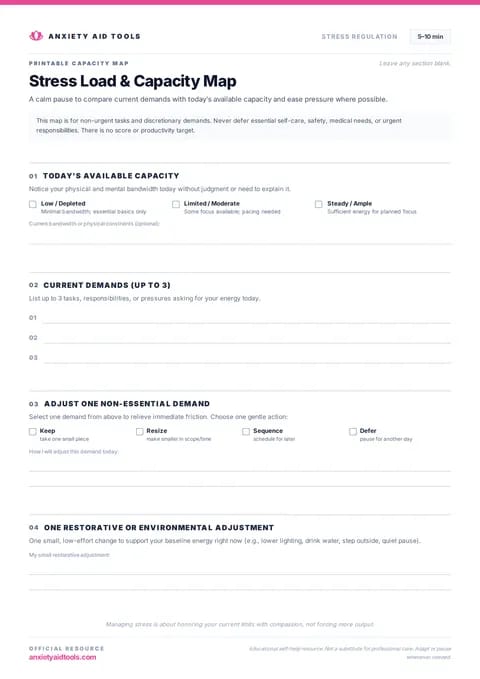
Stress Load & Capacity Map

A calm, one-page worksheet to compare current demands with available capacity, adjust non-essential load, and choose a small restorative ease.

Anxiety & Worry
Beginner
5–10 min
Stress Load & Capacity Map
Pro download PDF & PNG

Overview

Print for offline use during therapy or self-practice

Printable PDF and PNG formats available in your Pro dashboard

When to Use

  • When feeling overextended or pressured by multiple competing tasks
  • On days when your energy or focus is limited and demands exceed bandwidth
  • To make intentional choices about what to defer, resize, or sequence
  • Before planning your day to establish a realistic, compassionate pace

How to Use

  1. 1
    Check today's capacity: Notice your current physical, mental, and emotional energy without self-criticism.
  2. 2
    Map up to 3 demands: Write down up to 3 specific tasks or pressures currently on your plate.
  3. 3
    Adjust one non-essential demand: Choose one demand to keep, resize (make smaller), sequence (schedule for later), or defer (pause).
  4. 4
    Choose restorative ease: Identify one tiny environmental or restful adjustment (e.g., lower lighting, take a quiet pause, hydrate).
  5. 5
    Remember that essential health, safety, and urgent care must always be preserved; adapt or skip sections as needed.

The Stress Load & Capacity Map is a quiet, single-page planning tool designed to help you balance what is asking for your energy against what you realistically have available today. Rather than pushing through overwhelm or judging your energy levels, this worksheet helps you clarify demands and make intentional adjustments.

Through a straightforward four-step flow, you check today's baseline capacity, map up to 3 active demands, choose one non-essential demand to keep, resize, sequence, or defer, and select one small restorative or environmental change to support your nervous system.

This worksheet includes an explicit care and optionality boundary: essential self-care, safety, medical needs, and urgent duties should never be deferred. There are no scores, productivity quotas, or expectations of immediate calm—only practical, grounded ease.
Research & References

  • Lazarus, R. S., & Folkman, S. (1984). Stress, Appraisal, and Coping. Springer Publishing Company.
  • Hobfoll, S. E. (1989). Conservation of resources: A new attempt at conceptualizing stress. American Psychologist, 44(3), 513-524.